



Surrogate Parents
The Individuals with Disabilities Act (IDEA) gives parents an active role in planning their children's educational programs, monitoring progress, and challenging inappropriate decisions. Though the role of advocate for a child is usually filled by parents, the laws allow for a surrogate parent to act in this role if the parents or other family members of a child with a disability are unknown or completely unavailable, if the child is a ward of the state, if the child is an unaccompanied homeless youth, or if the parent requests in writing that a surrogate parent be appointed for their child. In some cases, a foster parent may serve as the parent and no surrogate parent need be appointed.
Surrogate parents fulfill an important role in the life of a child with a disability. Like parents, surrogates of children with disabilities are granted a significant decision-making role and are involved at every step of the special education process. The absence of a parent can deny a child’s access to appropriate identification, evaluation, placement, and provision of a free appropriate public education (FAPE).
The Role of Surrogate Parents in Special Education: Surrogate Parent Laws & Guidelines
Surrogate Parent Laws and Guidelines
Children who need surrogate parents
Students who either already receive special education services or who are thought to need such services are entitled to a free appropriate public education and may be served by surrogate parents. In Minnesota, this includes students from birth to age 18.
Surrogate parents are appointed under three conditions: (Minnesota Rule 3525.2440)
- The parent is unknown or unavailable
- The pupil is a ward of the state
- The parent requests a surrogate parent in writing
Parents are not usually aware of their right to request a surrogate parent. When a potential situation arises, the parents should be notified of their right to request a surrogate parent. They should also be informed regarding the rights and responsibilities that the surrogate would assume in this role.
What is a surrogate parent?
A surrogate parent is a person appointed by a school district or court to represent a child with a disability who has or may need special education services. This person must not be receiving public funds to educate or care for the child. However, a foster parent may serve in the role of the parent in the special education process in some cases when certain conditions are met.
In some cases, a grandmother or other family member of a student is “acting as parent” or serving in the parental role. Surrogate rules do not apply in these cases since the child is not in need of a surrogate parent. (IDEA §300.30)
Responsibilities of surrogate parents
A surrogate parent is only responsible for representing the child when decisions about his or her special education program are made concerning: (IDEA §300.519)
- Identification of the need for the child to receive special education services
- Evaluation to determine his or her individual needs
- Design of his or her Individualized Education Program (IEP), including placement
- Ongoing reviews of educational progress
- Agreement or disagreement with the school district's educational proposals
In order to fulfill these responsibilities, the surrogate parent should learn about state and federal requirements for special education and about school district structure and procedures. The surrogate parent should also have an understanding of the pupil's disability and needs and have an ability to effectively advocate for the child. (Minnesota Rule 3525.2455 )
Although not a legal requirement, it may be best if the surrogate parent and child share a similar background, such as race or culture.
Some other qualities of an effective surrogate parent are:
- A commitment to learning about the child's educational needs and special education
- The ability to communicate constructively and effectively with school personnel
A surrogate parent appointment may only be removed by the school board. (Minnesota Rule 3525.2450)
Resources
Q&A: Identification of Parent for Participation in Special Education Planning for a Child with a Disability
This document from the Minnesota Department of Education provides helpful, general information to the public, to address questions raised by parents and school districts regarding identification of a parent to participate in special education planning for a child with a disability.
Training for Surrogate Parents
This 22-page guide from PACER Center provides an overview of surrogate parent regulations in IDEA and Minnesota law, strategies surrogate parents can use to support their effective representation of a child with a disability, and an introduction to the special education process and the educational rights of children and surrogate parents. Available for download at no cost.
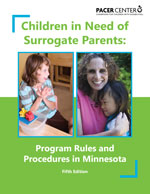
Children in Need of Surrogate Parents: Program Rules and Procedures in Minnesota
This 29-page manual from PACER Center is designed to assist school district administrators in implementing their surrogate parent programs, including the work of identifying students who need surrogate parents as well as recruiting, assigning, training, and terminating surrogate parents. Templates for many of the communication materials school districts may develop in support of this work are also included. Call 952-838-9000 to purchase. Cost is $9 for a single copy or $6 per manual for an order of more than 10.